
MACP ‘Very Good’ Benchmark Explained: APAR Score, 6.0 Rule, and MACP Eligibility
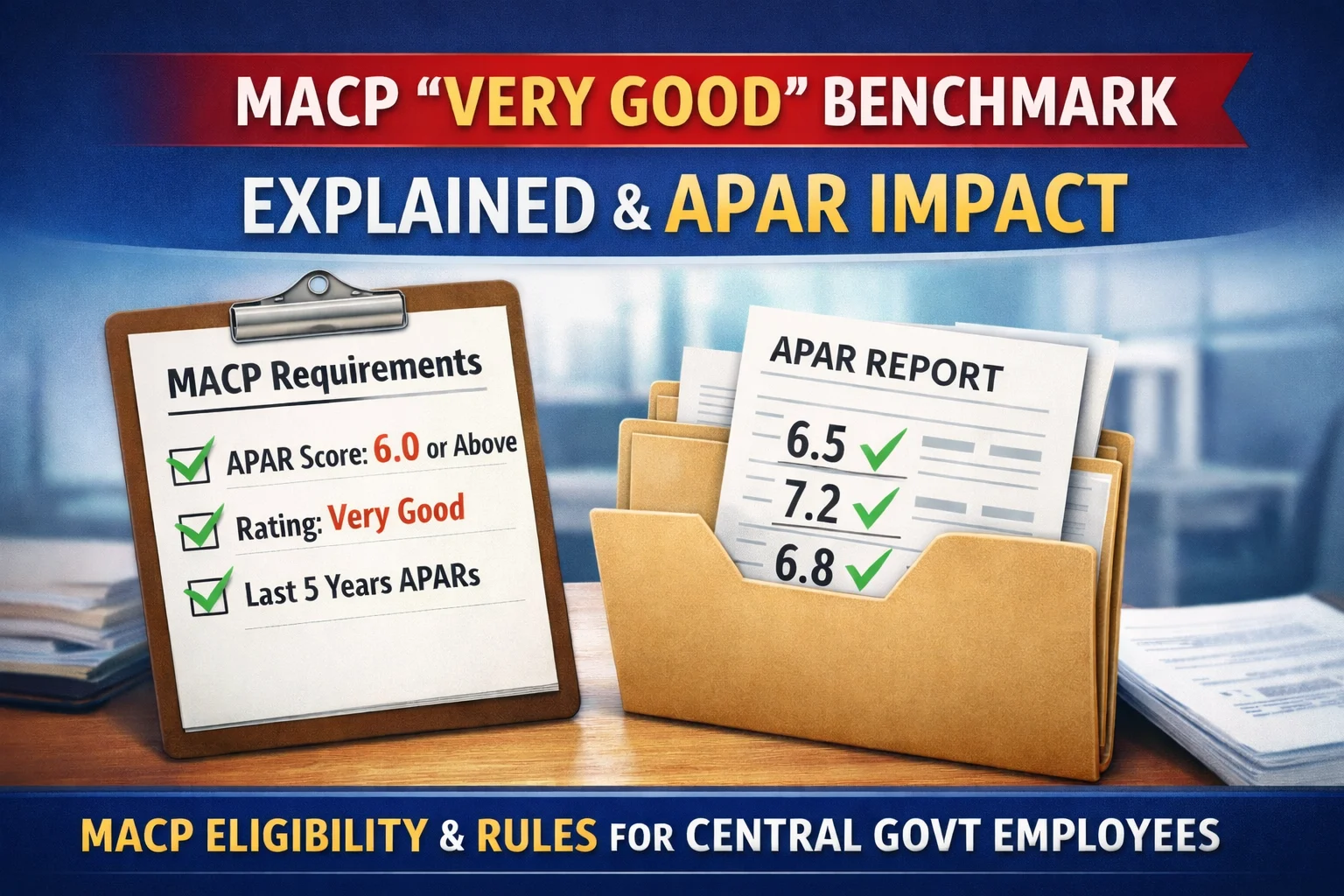
Every Central Government employee approaching the 10-, 20-, or 30-year mark in service hears the phrase “you need ‘Very Good’ in APAR for MACP.” But what does that actually mean in numbers? Which years count? And what happens if even one year falls short? This article answers all of that from official DoPT sources.
What Is the MACP Benchmark and Why Does It Matter?
The Modified Assured Career Progression Scheme (MACP) provides financial upgradation — a move to the next higher level in the Pay Matrix — after 10, 20, and 30 years of service, where regular promotions have not occurred. This is not an automatic entitlement. The employee must be found fit by a Departmental Screening Committee (DSC), and the primary measure of fitness is the benchmark grade in the Annual Performance Appraisal Report (APAR).
The benchmark is the minimum APAR grading an employee must have consistently earned to be considered eligible for a financial upgradation. Fall below it, and MACP is deferred — not cancelled permanently, but held back until the benchmark is met.
The ‘Very Good’ Benchmark: What the Numbers Say
APAR grades are assigned on a 10-point numerical scale. The overall score is calculated using a weighted formula: 40% for Work Output, 30% for Personal Attributes, and 30% for Functional Competency. As per DoPT guidelines on numerical grading (OM No. 21011/1/2010-Estt.A dated 14.05.2009), the score bands translate to verbal grades as follows:
| Overall Score Range | Verbal Grade | Standard Score Assigned | MACP Eligible? |
|---|---|---|---|
| 8.0 and above (up to 10) | Outstanding | 9 | ✅ Yes |
| 6.0 and above, below 8.0 | Very Good | 7 | ✅ Yes (minimum required) |
| 4.0 and above, below 6.0 | Good | 5 | ❌ Not sufficient (from 2016-17) |
| Below 4.0 | Average / Poor | 0 | ❌ No |
This means the minimum threshold for the MACP benchmark is an overall APAR score of 6.0 out of 10. A score of 5.9 places an employee in the ‘Good’ band — and falls short. A score of 6.0 places them at the floor of ‘Very Good’ — and they qualify. There is no rounding off; per DoPT instructions, the overall grading must be recorded as-is with up to two decimal places (e.g., 6.57 stays as 6.57).
When Did ‘Very Good’ Become the Benchmark?
The MACP benchmark was not always ‘Very Good’ for all posts. The original 2009 scheme had a tiered structure: ‘Good’ was sufficient for most posts up to Grade Pay of ₹6,000, and ‘Very Good’ was required only for Grade Pay of ₹7,600 and above.
The 7th Central Pay Commission recommended in Para 5.1.45 of its report that this benchmark be uniformly raised to ‘Very Good’ for all posts. The Government accepted this recommendation, and DoPT issued the formal order on 28 September 2016, with the change effective from 25 July 2016 — the date of acceptance of 7th CPC recommendations.
Which APARs Are Counted — and What Benchmark Applies to Each?
The Departmental Screening Committee (DSC) follows the same procedure as a Departmental Promotion Committee (DPC) for promotions. As per DoPT OM No. 22011/7/98-Estt.(D) dated 06.10.2000, the DPC (and by extension the DSC for MACP) assesses APARs for the five preceding years available at the time of consideration.
The critical distinction is the cut-off date of 25.07.2016. The applicable benchmark depends on which year the APAR covers:
| APAR Year | Applicable Benchmark | Governing Order |
|---|---|---|
| 2015-16 and earlier | ‘Good’ (or ‘Very Good’ for GP ₹7,600+) | DoPT OM dated 19.05.2009 |
| 2016-17 and onwards | ‘Very Good’ for all posts | DoPT OM dated 28.09.2016 / 22.10.2019 |
Practical Scenarios: Will MACP Be Granted?
Grades: VG, VG, VG, Good, VG
Result: MACP likely deferred. The 2021-22 ‘Good’ grading falls short of the ‘Very Good’ benchmark. The DSC will assess fitness holistically, but a below-benchmark year is grounds for deferral. The employee may represent against the ‘Good’ grading if they believe it is incorrect.
Result: MACP should be granted. For 2014-15 and 2015-16, ‘Good’ meets the then-applicable benchmark. From 2016-17 onwards, ‘Very Good’ is satisfied. All years meet the standard applicable to them.
Result: MACP granted. ‘Outstanding’ exceeds the ‘Very Good’ benchmark. One ‘Very Good’ year also meets the standard. Employee is clearly eligible.
How the Overall APAR Score Is Computed: The 40-30-30 Formula
The overall APAR grade that determines MACP eligibility is not a simple average of all columns. DoPT instructions specify a weighted formula:
The Reporting Officer records numerical grades (1–10) under three sections: (A) Work Output — which carries 40% weight; (B) Personal Attributes — 30%; and (C) Functional Competency — 30%. The mean score of each section is calculated by averaging all the individual indicators within it, and then the weighted total gives the overall grade.
The Reviewing Officer’s assessment is also factored in, and where an Accepting Authority is prescribed, their overall grade on a 1–10 scale is also recorded. The final overall grade determines which verbal band (‘Very Good’, ‘Good’, etc.) the APAR falls into. The grading must not be rounded off — 6.57 remains 6.57, not 6.6 or 7.
Your Right to Represent Against an APAR Grade
After an APAR is completed (by the Reporting and Reviewing Officers), the full APAR — including overall grade and all entries — must be communicated to the employee. Following the Supreme Court judgment in Dev Dutt v. Union of India [(2008) 8 SCC 725], DoPT issued OM No. 21011/1/2005-Estt.(A)(Pt-II) dated 14.05.2009, making it mandatory to communicate the full APAR — including overall grade and integrity assessment — to the employee after the report is complete.
The employee has 15 days from the date of communication to file a representation if they disagree with any entry or grading. If no representation is received within this period, the APAR is treated as final. No further opportunity for representation is ordinarily available after this window. The representation is decided by a competent authority above the Accepting Authority in a quasi-judicial manner, considering the views of the Reporting and Reviewing Officers.
What Happens When MACP Is Deferred Due to Benchmark Non-Compliance
When MACP is deferred because an employee does not meet the ‘Very Good’ benchmark, the deferral has a cascading effect. Under the consolidated MACP guidelines, if a financial upgradation is deferred at the 10-year mark, the subsequent 20-year and 30-year upgradations are also shifted accordingly. The scheme continues to operate at 10-year intervals from the direct entry grade, but the clock effectively restarts from when MACP is eventually granted.
Once the employee earns the requisite benchmark in subsequent APARs, the DSC can reconsider. There is no forfeiture of the right to MACP — only a postponement until the fitness condition is met.
Frequently Asked Questions
Key Takeaways
- The MACP benchmark is ‘Very Good’ for all posts, effective 25.07.2016 (DoPT OM dated 28.09.2016).
- ‘Very Good’ means an overall APAR score of 6.0 to below 8.0 on the 10-point scale. The absolute minimum is 6.0.
- The overall APAR score is computed as: 40% Work Output + 30% Personal Attributes + 30% Functional Competency.
- The Departmental Screening Committee considers APARs of the five preceding years.
- For APAR years 2015-16 and before, the old benchmark (‘Good’ for most posts) continues to apply.
- You have 15 days after receiving your APAR to represent against any grading you disagree with. Act promptly.
- A deferred MACP is not lost — it is granted once the benchmark is met, but the delay has a cascading effect on subsequent upgradations.
📢 Stay Updated with GConnect
Join our Whatsapp channels for the latest news and job updates:
Join GConnect News Join GConnect Jobs
GConnect News

GConnect Jobs