
Can Government Employees File Service Grievances on CPGRAMS? Rules Explained
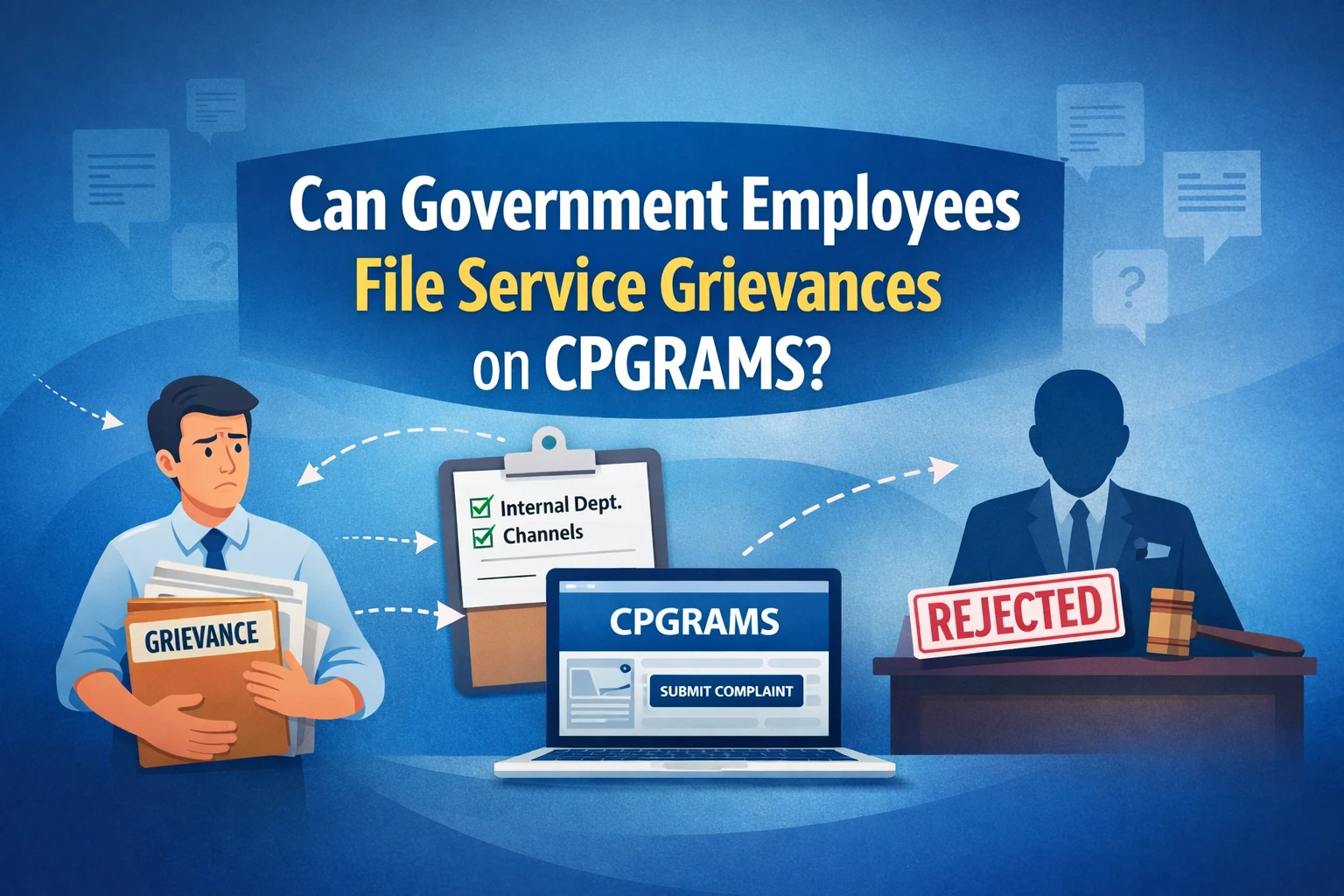
What is CPGRAMS?
The Centralised Public Grievance Redress and Monitoring System (CPGRAMS) is the Government of India’s online platform for receiving and resolving public grievances. The portal connects citizens with all Central Ministries, Departments, and State Governments through a single system.
CPGRAMS is administered by the Department of Administrative Reforms and Public Grievances (DARPG) under the Ministry of Personnel, Public Grievances & Pensions. Citizens can submit complaints, track their status, and file appeals through the portal available at pgportal.gov.in.
However, a common question among government employees is:
Can a serving government employee use CPGRAMS to raise service-related grievances such as pay, promotion, posting, MACP or leave issues?
The answer depends on one important condition.
Can Government Employees Use CPGRAMS for Service Matters?
The CPGRAMS portal itself provides the answer. Among the categories of grievances that are normally not taken up for redress, the portal states:
“Grievances of Government employees concerning their service matters including disciplinary proceedings etc. unless the aggrieved employee has already exhausted the prescribed channels keeping in view the DoPT OM No. 11013/08/2013-Estt.(A-III) dated 31.08.2015.”
In simple terms: a serving government employee cannot use CPGRAMS as the first channel for service matters. The employee must first try to resolve the issue through the prescribed departmental hierarchy. Only after those channels have been genuinely exhausted can CPGRAMS be approached.
The Long-Standing Rule on Service Representations
The requirement to follow proper channels for service matters is not new. Government instructions on this subject date back to the 1950s.
A Ministry of Home Affairs circular issued in 1952 laid down the basic principle that whenever a Government servant wishes to press a claim or seek redress regarding service conditions, the proper course is to address the matter to the immediate superior officer or the competent authority within the organisation.
This principle was reiterated in later instructions issued in 1968 and 1999, mainly because employees continued to bypass prescribed channels and approach higher authorities directly. The rule has therefore remained consistent for decades: service grievances must first be addressed within the departmental hierarchy.
The 2013 DoPT OM: Clear Instructions to Follow Proper Channel
The Department of Personnel & Training issued OM No. 11013/08/2013-Estt.(A-III) dated 6 June 2013 after it was observed that government servants were frequently submitting representations directly to senior authorities such as Ministers, Secretaries and even the Prime Minister’s Office.
The OM reiterated that a government servant with a service grievance must first submit the representation through the proper channel, beginning with the immediate official superior.
The circular warned that bypassing the prescribed channel could be treated as unbecoming conduct under Rule 3(1)(iii) of the CCS (Conduct) Rules, 1964, which may attract disciplinary action. Additionally, Rule 20 of the CCS (Conduct) Rules prohibits government servants from bringing outside influence in matters relating to their service.
The 2015 DoPT OM: The Key Clarification Covering CPGRAMS
The most important instruction on this subject is the DoPT OM dated 31 August 2015, which is also the circular referenced on the CPGRAMS portal. This OM reiterated the 2013 instructions because violations were continuing across departments. It also added a crucial clarification:
“This would include all forms of communication including through e-mails or public grievances portal etc.”
This means that filing a service grievance on a public grievance portal such as CPGRAMS without first exhausting departmental channels is treated in the same way as directly approaching senior authorities, and may attract disciplinary proceedings under Rule 3(1)(iii) of the CCS (Conduct) Rules, 1964.
What “Exhausting Prescribed Channels” Means
Government employees often wonder what exactly is meant by exhausting departmental channels. In general, the following process should be followed:
Maintaining records of earlier representations, including dates, acknowledgements and diary numbers, is important if the grievance is later raised on CPGRAMS.
Grievances That Are Not Entertained on CPGRAMS
The CPGRAMS portal lists several categories of grievances that are not taken up for redress:
Must be handled through the RTI Act mechanism and are not entertained on CPGRAMS.
Matters already pending before courts or tribunals are excluded from CPGRAMS.
Grievances relating to religious matters are not within the scope of CPGRAMS.
These fall under a conditional exclusion — they may be considered only if departmental channels have already been exhausted.
Key Features of the 2024 CPGRAMS Guidelines
DARPG issued updated Comprehensive Guidelines for Handling Public Grievances in August 2024 to improve the effectiveness of CPGRAMS. Some important provisions include:
Grievances on the portal must be resolved within 21 days.
Dissatisfied applicants can file an appeal within 30 days of the initial decision.
These reforms aim to improve grievance handling for citizens. However, the basic rule regarding service grievances of government employees remains unchanged.
Summary: When Can Government Employees Use CPGRAMS?
| Situation | Can CPGRAMS Be Used? |
|---|---|
| Citizen grievance not related to service | ✔ Yes |
| Service grievance – departmental channel not yet tried | ✖ No |
| Service grievance – departmental channels exhausted | ✔ Yes |
| Disciplinary proceedings ongoing | ✖ Generally No |
| Matter pending before court or tribunal | ✖ No |
| RTI-related matter | ✖ No |
| Religious matter | ✖ No |
Practical Advice for Government Employees
If you are a serving government employee facing a service-related issue, the following approach is advisable:
Always begin by addressing the matter to your immediate superior officer.
Keep copies of representations along with acknowledgement numbers or diary entries.
Government instructions generally consider around one month as a reasonable period for disposal of representations.
If the matter is not resolved, approach the Head of Office or the next competent authority.
When filing a grievance on CPGRAMS, clearly mention that departmental channels have already been tried and include details of earlier representations.
Using CPGRAMS prematurely can result in closure of the grievance and may even invite disciplinary action under the CCS (Conduct) Rules.
Conclusion
CPGRAMS is an important platform for citizens to seek redress of grievances against public authorities. For serving government employees, however, it is not intended to replace the departmental grievance mechanism for service matters. Government instructions issued over several decades — culminating in the DoPT Office Memoranda of 2013 and 2015 — make it clear that service grievances must first be addressed through the prescribed official channels within the department. Only after those channels have been genuinely exhausted may CPGRAMS be approached as a last resort. Understanding this distinction can help government employees avoid unnecessary rejection of grievances and ensure that service issues are raised through the proper procedure.
Source Documents
- CPGRAMS Portal — Official Website
https://pgportal.gov.in/ - DoPT OM dated 06.06.2013 – Representation from Government Servants on Service Matters
https://documents.doptcirculars.nic.in/D2/D02est/11013_08_2013-Estt-A-III.pdf - DoPT OM dated 31.08.2015 – Reiteration of Instructions on Service Representations
pgportal.gov.in (OM on Service Matters, 31-08-2015) - DARPG OM dated 23.08.2024 – Comprehensive Guidelines for Handling Public Grievances
pgportal.gov.in (Comprehensive Guidelines, 23-08-2024)
📢 Stay Updated with GConnect
Join our Whatsapp channels for the latest news and job updates:
Join GConnect News Join GConnect Jobs
GConnect News

GConnect Jobs