
Fitment Factor Explained: Why Pay Commission Salary Hikes Look Bigger Than They Are
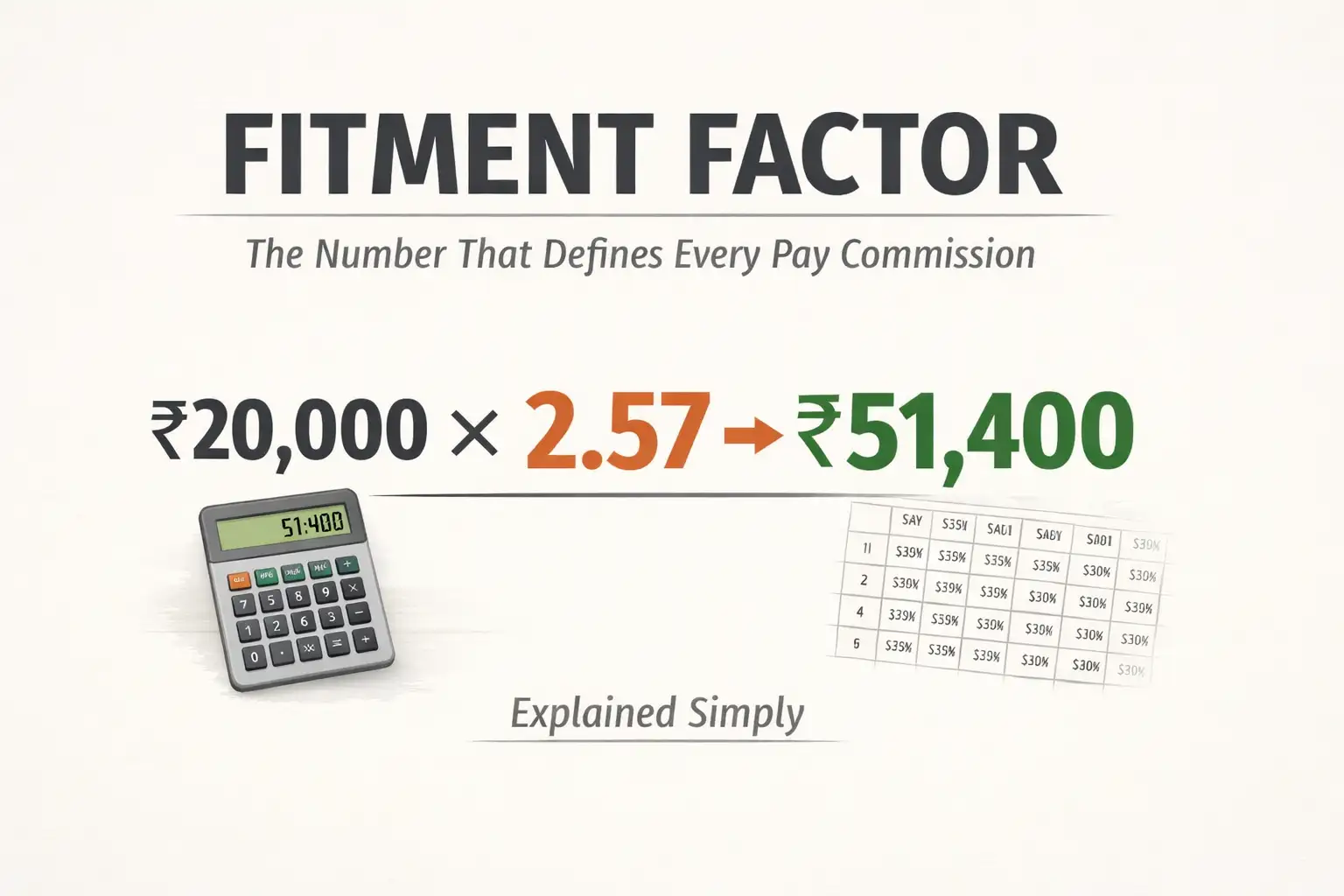
Every Pay Commission produces one number that gets everyone talking. Here’s what it really means — and why it’s never quite as good as it sounds.
What Is the Fitment Factor?
Every decade or so, the Government of India convenes a Pay Commission to revise the salaries of its central government employees. When the dust settles, one number defines the entire exercise in public conversation: the fitment factor — the multiplier applied to an employee’s existing basic pay to arrive at the revised pay.
Simple enough. But the headline number hides a story — because a large chunk of that multiplication isn’t “new money” at all.
The DA Trap: Why 2.57× Isn’t a 157% Raise
Here’s what most people miss. Between pay revisions, the government pays Dearness Allowance (DA) — a twice-yearly inflation adjustment based on the Consumer Price Index. By the time a new Pay Commission is implemented, DA has typically ballooned to 50%, 100%, even 125% of basic pay.
When the new pay structure kicks in, that accumulated DA is merged back into basic pay. So the fitment factor isn’t multiplying your old basic pay from a position of zero — it’s multiplying it to first absorb the DA you were already receiving, and only then adding something new on top.
“The real wage increase is only the portion of the fitment factor that exceeds the DA already in your pocket. The rest is a repackaging, not a raise.”
When the 7th Pay Commission applied a 2.57× fitment factor in January 2016, DA stood at 125%. An employee on ₹10,000 basic was already getting ₹12,500 as DA — total effective pay: ₹22,500. The 2.57× gave a new basic of ₹25,700. The actual increase? Just ₹3,200 — roughly 14.3% net. Not quite the 157% the headline number implies.
Net Increase = (Old Basic × Fitment Factor) − (Old Basic + Old DA Amount). Always calculate this before celebrating the fitment factor announcement.
A Quick Look Back: Pay Commissions in Comparison
The fitment factor has evolved across Pay Commissions, and comparing them without context is misleading — each operated under very different inflation and structural conditions.
| Commission | Year | Fitment Factor | DA Merged | Net Real Increase |
|---|---|---|---|---|
| 4th Pay Commission | 1987 | 2.57× | Partial | ~20–25% |
| 5th Pay Commission | 1997 | 3.25× | 148% | ~20–25% |
| 6th Pay Commission | 2006 | 1.86× + Grade Pay | 50% | ~25–30% |
| 7th Pay Commission | 2016 | 2.57× | 125% | ~14.3% |
Notice the paradox: the 5th Pay Commission had the highest fitment factor (3.25×), but its real increase was not dramatically better than the 4th — because it was absorbing a massive 148% DA. Meanwhile, the 6th CPC’s fitment looks smaller on paper, yet delivered a higher net increase because DA was only 50% at the time.
The 7th CPC’s 2.57× factor — identical to the 4th CPC’s three decades earlier — delivered the lowest net real increase of the modern era, precisely because 125% DA had to be absorbed first. This is why employees’ unions, who demanded 3.68×, felt shortchanged even when the numbers on paper seemed respectable.
6th vs. 7th: A structural note. The 6th CPC used a Pay Band + Grade Pay structure, making the fitment comparison complex. The 7th CPC replaced this with a clean 18-level Pay Matrix with a uniform 2.57× applied to all — simpler to understand, even if the outcome disappointed many.
What to Watch for in the 8th Pay Commission
The 8th Pay Commission was constituted in late 2025, with January 1, 2026 set as the notional effective date — meaning arrears will be calculated from that point. But the commission has an 18-month mandate to submit its report, which puts actual salary crediting at late 2027 or early 2028 at the earliest.
DA currently stands at 58% as of July 2025, with the January 2026 revision due but not yet announced — expected to push it to around 60–62%. By the time the revised pay structure lands in employees’ accounts — likely 2027–28 — DA will have continued accumulating. Conservative projections put it at 68–72% by then, possibly higher.
Employees’ unions are pressing for a fitment factor between 2.86× and 3.68×, with most expert estimates clustering around 2.86–3.0. But the same DA arithmetic applies: with 68–70% DA to absorb at implementation, a factor of 3.0 would still deliver a net real increase of roughly 25–30% — better than the 7th CPC’s 14.3%, but not the headline figure it appears to be.
The number to watch isn’t just the fitment factor — it’s the DA level on the day revised salaries are actually credited. That gap between the notional January 2026 date and real implementation is where the DA quietly keeps climbing, slowly eating into whatever multiplier the commission eventually recommends.
The fitment factor, in the end, is not a magic number. It is the sum of inflation absorbed, DA neutralised, and — if the commission is generous enough — a little extra for the years of service in between.
Frequently Asked Questions
Quick answers to the most common questions about the fitment factor.
The fitment factor is a multiplier used by India’s Pay Commission to convert a central government employee’s existing basic pay into the revised basic pay under the new pay structure. The formula is simple: Revised Basic Pay = Old Basic Pay × Fitment Factor. The 7th Pay Commission used a uniform fitment factor of 2.57 for all employees.
Because a large portion of the fitment factor is used to absorb the accumulated Dearness Allowance (DA) employees have been receiving since the last pay revision. DA is merged into basic pay when the new structure kicks in, so the multiplier first neutralises that DA before providing any genuine new increase. The real net increase is: (Old Basic × Fitment Factor) minus (Old Basic + DA Amount).
The 7th Pay Commission (2016) set a uniform fitment factor of 2.57 for all central government employees. However, since DA stood at 125% at the time of implementation, the net real salary increase worked out to approximately 14.3% — far less than the 157% the headline number might imply.
The 5th Pay Commission (1997) had the highest fitment factor at 3.25×. But it was simultaneously absorbing 148% accumulated DA, which meant the net real increase was broadly similar to other commissions — around 20–25%. This illustrates the key lesson: a higher fitment factor does not automatically mean a larger real salary increase.
The 8th Pay Commission was constituted in late 2025, with January 1, 2026 as the notional effective date. However, the commission has an 18-month mandate, meaning actual salary crediting is expected in late 2027 or early 2028, with arrears backdated to January 2026. DA currently stands at 58% (July 2025), with the January 2026 revision due but not yet announced, and is projected to reach 68–72% by the time revised pay is actually implemented. Employees’ unions have demanded a fitment factor between 2.86× and 3.68×, with most estimates clustering around 2.86–3.0.
A salary hike percentage is the straightforward increase in your effective take-home. The fitment factor is a gross multiplier applied to basic pay — and includes the absorption of accumulated DA. To find your actual hike, subtract your pre-revision effective pay (basic + DA) from your post-revision basic pay, and express that difference as a percentage of your pre-revision effective pay.