
IRTSA Flags Key Issues in 8th CPC Online Submission Process, Seeks Major Revisions
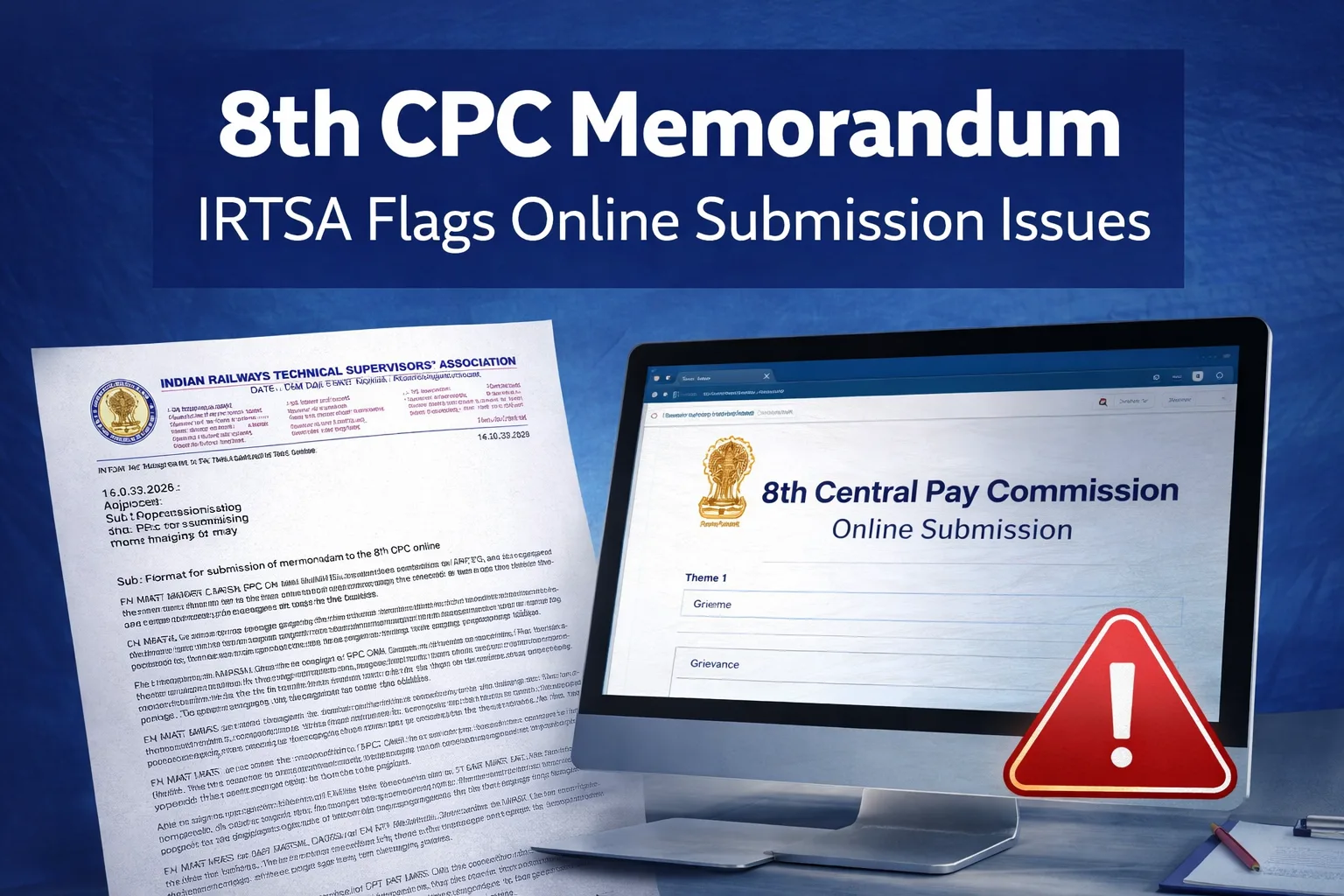
In a memorandum dated March 16, 2026, the Indian Railways Technical Supervisors’ Association (IRTSA) has raised multiple concerns regarding the format and structure of online submissions for the 8th Central Pay Commission (CPC). The association has urged the Commission to address several limitations in the current system to ensure comprehensive representation of employees’ views.
Concerns Over Limited Coverage of Themes
IRTSA pointed out that the nine themes provided for online submissions do not adequately cover all issues addressed by previous Pay Commissions. The association has requested an increase in the number of themes so that all relevant aspects are included, considering the experience and scope of earlier commissions.
Character Limit and Documentation Constraints
A major concern highlighted is the restriction of 3,500 characters for each submission. According to IRTSA, this limit is insufficient for presenting detailed concerns. Additionally, the provision of only one supporting document per theme has been termed inadequate. The association has recommended substantially increasing character limits and allowing multiple supporting documents without restrictive size constraints.
Lack of Provisions for Multiple Categories
IRTSA noted the absence of provisions for submitting concerns across multiple categories or designations. The association, representing various technical cadres in Indian Railways, emphasized the need for category-specific submissions to reflect distinct issues faced by different groups.
Inadequate Coverage of Allowances
The memorandum observed that while the 7th CPC dealt with 196 allowances, the 8th CPC themes mention only 12 groups of allowances. IRTSA stated that this broad grouping is insufficient and called for expanding the scope to cover all allowances comprehensively.
Pension and Retirement Benefits
The association highlighted that the current framework does not adequately address pension and family pension issues. It has urged the Commission to expand this theme to include all retirement-related benefits.
Career Progression and MACPS
IRTSA raised concerns about the treatment of career progression under the Modified Assured Career Progression Scheme (MACPS). It suggested that career progression should be aligned more closely with functional promotions and requested appropriate modifications.
Classification of Posts
The memorandum emphasized the need to review the existing classification of posts into Groups A, B, and C. Given changes in job roles, responsibilities, and technological advancements, IRTSA has called for a comprehensive review by the 8th CPC to develop an updated framework.
Inclusion of Court Judgments
IRTSA has recommended that provisions be made for submitting judgments from the Central Administrative Tribunal (CAT), High Courts, and the Supreme Court that are relevant to employees’ issues.
Submission of Physical Memoranda
While welcoming the online submission process, the association has requested that unions and associations also be allowed to submit physical copies of memoranda in addition to online submissions.
Conclusion
The memorandum reflects significant concerns from technical supervisors in Indian Railways regarding the current 8th CPC submission framework. IRTSA has urged the Commission to make the process more inclusive, flexible, and comprehensive to ensure that all employee concerns are effectively represented.
View IRTSA Memorandum:
 Loading…
 Reload document
 Open in new tab
 📢 Stay Updated with GConnect
Join our Whatsapp channels for the latest news and job updates:
Join GConnect News Join GConnect Jobs
GConnect News

GConnect Jobs