
CGHS Issues Guidelines for Prescription of Injectable GLP-1 Drugs for Obesity and Type-2 Diabetes
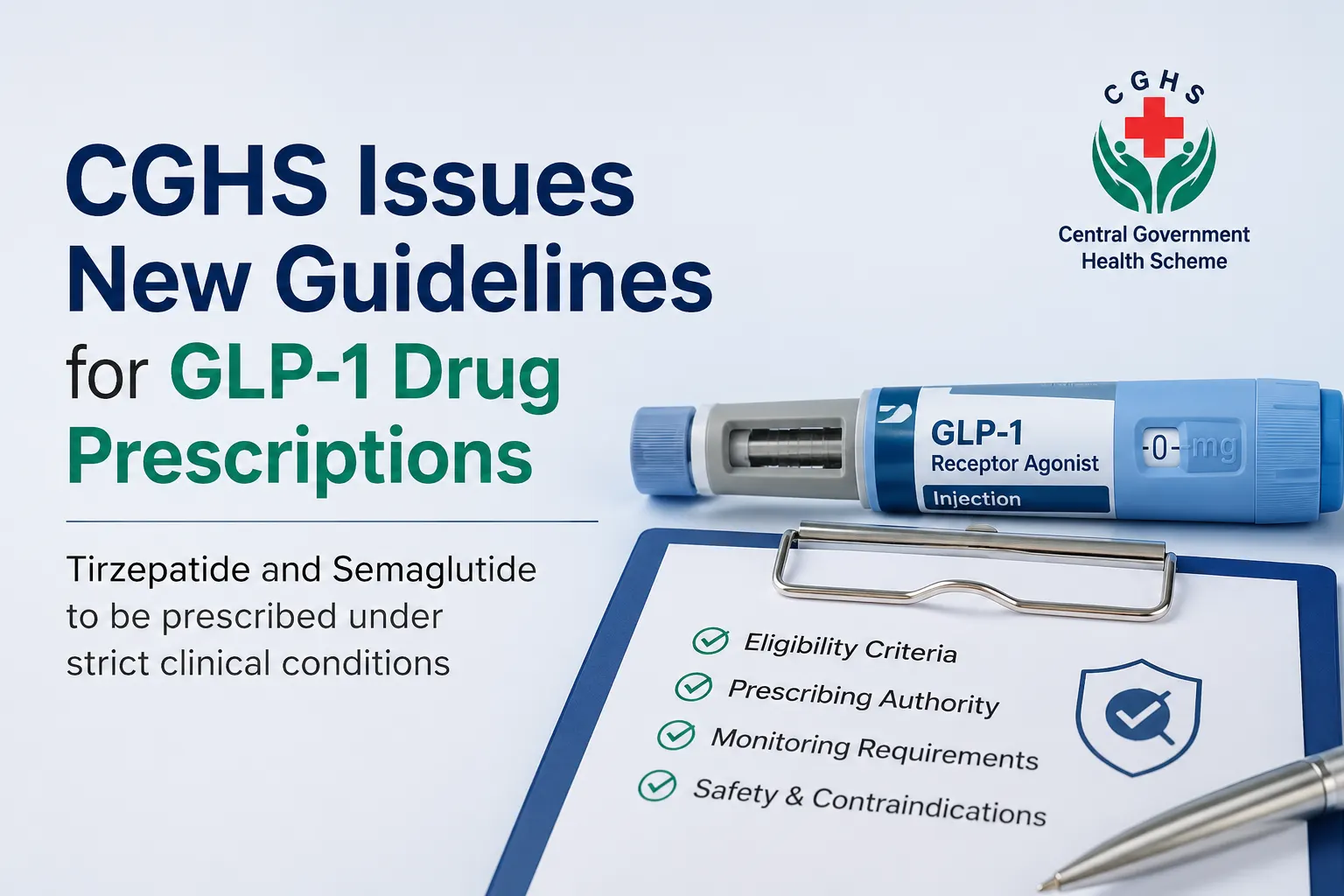
The Ministry of Health & Family Welfare has issued comprehensive guidelines regulating the prescription of Injectable GLP-1 Receptor Agonists under the Central Government Health Scheme (CGHS) and the Central Services (Medical Attendance) Rules, 1944. The new Office Memorandum introduces Injection Tirzepatide (Mounjaro) into the CGHS Online List of Restricted Drugs while also prescribing uniform conditions for the use of Injection Semaglutide.
The guidelines aim to ensure that these high-cost medicines are prescribed only to eligible beneficiaries based on defined clinical criteria and under specialist supervision.
Tirzepatide Added to Restricted Drug List
Following a review of the clinical use of Injectable GLP-1 Receptor Agonists for obesity and Type-2 Diabetes Mellitus, the Ministry has approved the inclusion of Injection Tirzepatide (Mounjaro) in the CGHS Online List of Restricted Drugs.
Both Tirzepatide and Semaglutide will now be available under CGHS and CS(MA) Rules only in accordance with the newly notified prescribing guidelines. The instructions have come into effect immediately and are mandatory for all CGHS Wellness Centres and empanelled healthcare organisations.
Who is Eligible?
GLP-1 Receptor Agonists may be prescribed only to beneficiaries meeting either of the following criteria:
- Body Mass Index (BMI) of 35 kg/m² or above, or
- BMI of 32.5 kg/m² or above along with at least one of the following medical conditions:
- Uncontrolled Type-2 Diabetes despite treatment with Metformin and at least two other oral anti-diabetic medicines.
- Severe Obstructive Sleep Apnoea.
- Atherosclerotic Cardiovascular Disease.
- Metabolic Dysfunction-Associated Steatotic Liver Disease (MASLD).
- Chronic Kidney Disease (CKD).
Conditions Where These Medicines Cannot Be Prescribed
The guidelines prohibit the use of Injectable GLP-1 Receptor Agonists in beneficiaries with:
- History of pancreatitis.
- Personal or family history of Medullary Thyroid Carcinoma (MTC) or Multiple Endocrine Neoplasia Type-2 (MEN2).
- Pregnancy or lactation.
- Severe Non-Proliferative or Proliferative Diabetic Retinopathy.
- Severe gastroesophageal reflux disease (GERD), gastroparesis, inflammatory bowel disease, or history of metabolic/bariatric surgery.
Lifestyle Measures Mandatory Before Treatment
Before initiating therapy, the treating specialist must certify that the beneficiary has:
- Undertaken lifestyle modification.
- Received dietary counselling.
- Followed a supervised physical activity programme.
- Complied with these measures for at least three months.
This requirement reinforces that injectable GLP-1 medicines are intended only after sustained non-pharmacological interventions have been attempted.
Prescription Restricted to Government Specialists
The Office Memorandum places strict controls on prescribing authority:
- Prescription can be issued only by an Endocrinologist or an Internal Medicine Specialist of a Government Hospital.
- Every prescription must be endorsed by the concerned Head of Department (HoD).
- Approval remains valid for six months.
- Continuation beyond six months requires fresh specialist recommendation and a new HoD endorsement.
Regular Monitoring Made Mandatory
Beneficiaries receiving GLP-1 therapy must undergo structured follow-up:
- Monthly reviews during the first three months.
- Follow-up every three months thereafter.
The treating specialist must monitor and document:
- Weight reduction.
- Clinical response.
- Gastrointestinal side effects.
- Evidence of pancreatitis.
- Muscle wasting.
- Any other adverse drug reactions.
Continuation of treatment will depend on documented clinical benefit and an acceptable safety profile.
Specialist Certification Required
The Ministry has also prescribed a standard certification format to accompany every prescription. The specialist must record:
- Current body weight.
- Body Mass Index (BMI).
- Presence or absence of contraindications.
- Confirmation that lifestyle modification has been completed for at least three months.
If any contraindication such as pancreatitis, Medullary Thyroid Carcinoma history, pregnancy, severe diabetic retinopathy, or specified gastrointestinal disorders is present, GLP-1 therapy should not be prescribed.
Immediate Implementation Across CGHS
The Ministry has directed all Additional Directors of CGHS to ensure strict implementation of these guidelines across CGHS Wellness Centres and empanelled healthcare organisations. Any deviation from the prescribed norms will be viewed seriously.
The new framework is expected to standardise the use of Injectable GLP-1 medicines under CGHS while ensuring that these therapies are reserved for beneficiaries who meet clearly defined clinical criteria and receive appropriate specialist supervision.
View OM:
 Loading…
 Reload document
 Open in new tab
 📢 Stay Updated with GConnect
Join our Whatsapp channels for the latest news and job updates:
Join GConnect News Join GConnect Jobs
GConnect News

GConnect Jobs