
No Proposal to Restore OPS at Centre, Government Tells Lok Sabha
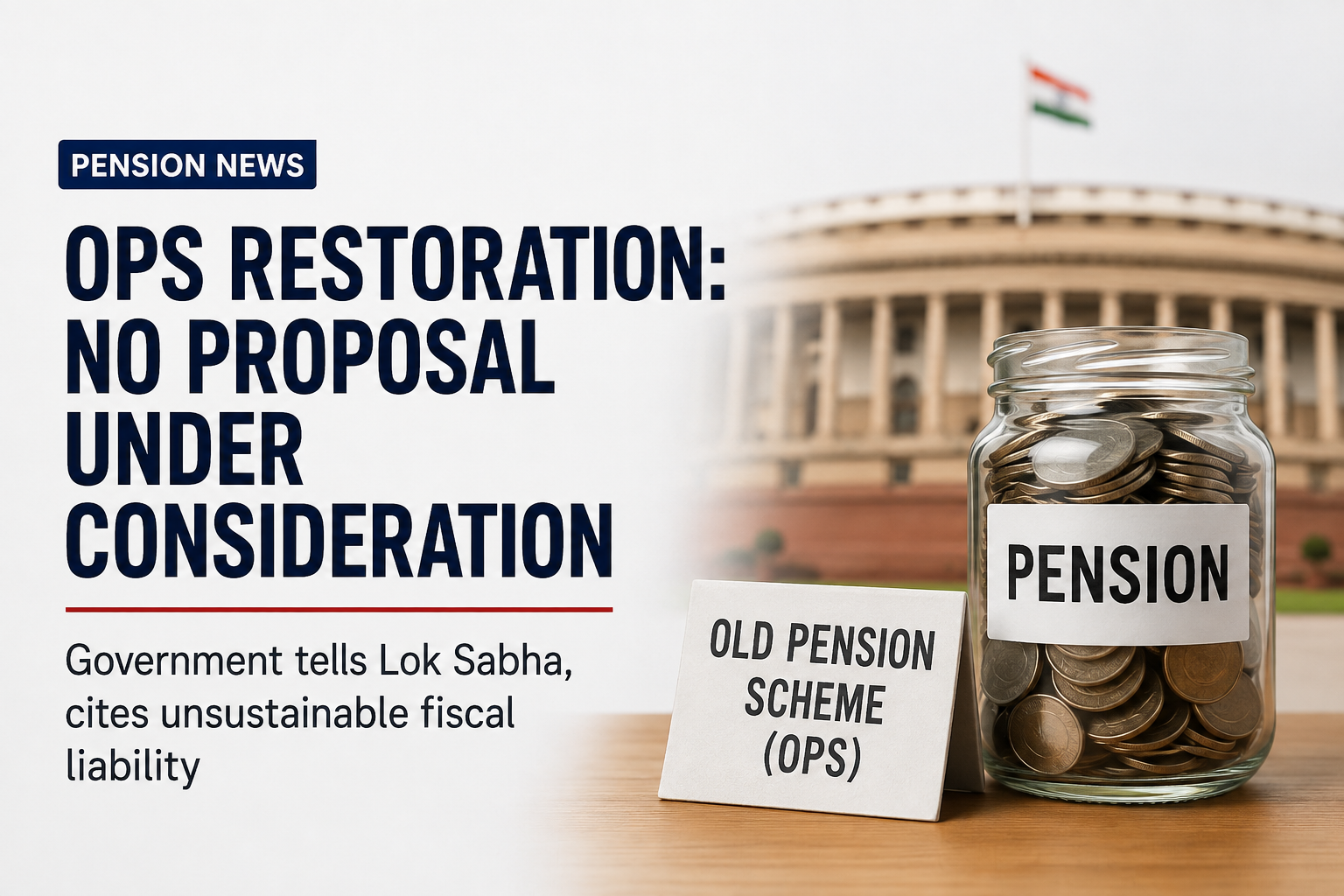
The Government of India has ruled out any proposal to restore the Old Pension Scheme (OPS) for Central Government employees, citing the scheme’s unsustainable fiscal liability on the government exchequer. The position was conveyed in the Lok Sabha on August 10, 2026, in response to questions on the restoration of OPS and its implementation.
The issue of restoring the Old Pension Scheme continues to remain a major concern among government employees, particularly those covered under the National Pension System (NPS). Responding to two separate Lok Sabha questions, the Ministry of Finance clarified that the Government of India currently has no proposal under consideration to bring back OPS.
Government cites unsustainable fiscal burden of OPS
In response to Lok Sabha Unstarred Question No. 3637, Minister of State for Finance Shri Pankaj Chaudhary stated that there is no proposal to restore OPS because of its unsustainable fiscal liability on the Government exchequer.
The Government also reiterated that the restoration of OPS in the States falls within the policy discretion of the respective State Governments.
The Government’s response comes against the backdrop of several States reverting, or deciding to revert, from NPS to OPS. The Government pointed out that the Comptroller and Auditor General (CAG) has highlighted the fiscal implications associated with such reversions in its recent State Finance Audit Reports.
No Central Government proposal for OPS restoration
The Government’s response makes the Central position clear: OPS restoration is not currently under consideration at the Central Government level.
The Finance Ministry had earlier moved away from OPS because of the long-term financial liability it places on the government. The NPS was introduced for Central Government employees, other than members of the armed forces, who joined service on or after January 1, 2004.
Unlike OPS, NPS operates as a defined contribution-based pension system, with contributions from employees and the Government.
Unified Pension Scheme introduced as an alternative
The Government also highlighted the introduction of the Unified Pension Scheme (UPS) as a measure to improve pensionary benefits for Central Government employees covered under NPS.
UPS was introduced with effect from April 1, 2025, as an option under NPS. According to the Government, the scheme seeks to provide inflation-linked defined benefits, including a minimum assured payout of ₹10,000 per month after retirement, subject to the applicable conditions of the scheme.
The Government explained that UPS is a fund-based payout system. The assured retirement payout depends on the regular and timely accumulation and investment of applicable contributions made by both the employee and the Central Government.
NPS corpus for Central Government employees reaches ₹3.65 lakh crore
The Finance Ministry also provided an updated figure for the assets accumulated under NPS for Central Government employees.
As of July 26, 2026, the total Assets Under Management (AUM) under NPS for Central Government employees stood at:
₹3.65 lakh crore
This figure reflects the substantial corpus accumulated under the NPS framework for Central Government employees.
Five States have informed Government/PFRDA about OPS reversion
In the second Lok Sabha response, the Government provided details of States that have informed the Government or the Pension Fund Regulatory and Development Authority (PFRDA) about their reversion from NPS to OPS.
As on July 26, 2026, the NPS assets under management associated with these States were:
| State | NPS AUM |
|---|---|
| Rajasthan | ₹53,403.89 crore |
| Chhattisgarh | ₹24,030.04 crore |
| Jharkhand | ₹14,420.90 crore |
| Punjab | ₹40,673.08 crore |
| Himachal Pradesh | ₹12,525.96 crore |
The figures indicate that significant pension assets remain accumulated under NPS in respect of employees of these States.
NPS corpus cannot simply be returned to States
An important clarification from the Government concerns the demand for returning the accumulated NPS corpus to States that have reverted to OPS.
The Finance Ministry stated that there is no provision under the PFRDA Act, 2013, read with the PFRDA (Exits and Withdrawals under the National Pension System) Regulations, 2015 and other relevant regulations, to refund the accumulated corpus comprising Government contributions, employee contributions and accrued returns and deposit it back with the State Government.
This effectively means that the accumulated NPS corpus cannot simply be transferred back to the concerned State Governments under the existing regulatory framework.
OPS vs NPS vs UPS: What the Government’s response indicates
The Government’s latest Lok Sabha replies establish three important points:
- OPS: No proposal is currently under consideration for restoration for Central Government employees.
- NPS: Continues as the defined contribution-based pension framework for Central Government employees covered by it.
- UPS: Available under NPS from April 1, 2025, providing inflation-linked defined benefits and a minimum assured payout of ₹10,000 per month, subject to scheme conditions.
- State OPS decisions: Restoration of OPS in individual States remains within the respective State Governments’ policy domain.
- NPS corpus: The accumulated corpus cannot be returned to States under the existing PFRDA legal and regulatory framework.
What this means for Central Government employees
The latest clarification is significant for Central Government employees seeking restoration of OPS. The Government has categorically stated that there is currently no proposal to restore OPS at the Central level.
Instead, the Government’s stated approach is to improve pension benefits within the NPS framework, principally through the Unified Pension Scheme, while retaining a fund-based pension structure.
The Government’s response also places emphasis on the long-term fiscal implications of OPS, indicating that the issue of pension reform continues to be viewed from the perspective of both employee benefits and the sustainability of government finances.
View PQ:
 Loading…
 Reload document
 Open in new tab
 📢 Stay Updated with GConnect
Join our Whatsapp channels for the latest news and job updates:
Join GConnect News Join GConnect Jobs
GConnect News

GConnect Jobs