
What is One Rank One Pension ? – A Walk-through on OROP
What is One Rank One Pension ? – A Brief on OROP and the reasons for why it is needed by Defence Personnel ?
Though One Rank One Pension is very long pending issue since 1980, it has started occupying front pages nowadays on account of desperate voices of ex-servicemen. Defence Personnel deserve OROP but how a civilian understands the need of OROP ? After all he / she pays taxes and requires proper understanding of major expenditures to exchequer. We provided here a layman level brief of what is One Rank One Pension and why it is needed.
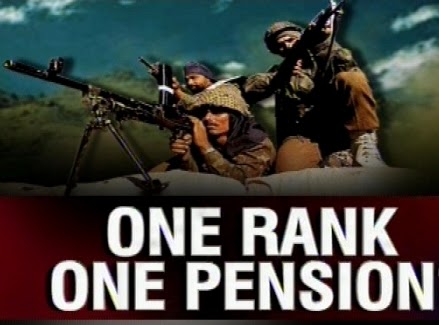
One Rank One Pension – A brief explanation:
While Defence Personnel retire they get Military Pension (Defence Pension) on the basis of number of years of service he / she served in the armed force Pay drawn by him / her while retiring from service and Rank he / she held at the time of retirement.
This system is okay but when the pay and allowances of serving defence personnel are revised en-masse such as pay revision due to implementation of pay commission report etc., prospective retirees would be fixed with higher pension than the pensioners who retire before such pay revision.
Though some benefits are provided to such pensioner retired before pay revision such as ensuring minimum of 50% revised pay in the rank in which the pensioner retired etc., are provided, Pension of Retirees in the Pre-Revision Period could not be equated with the Prospective Pensioners.
To rectify this Pension anomaly, Defence Personnel are demanding all these years for Payment of uniform pension which is called as One Rank One Pension.
One Rank One Pension scheme would take of care of payment of uniform pension to Defence Personnel retiring in same rank with same length of service, irrespective of date of retirement.
It is also demanded that any increase in prospective pension payment needs to be automatically passed on to past pensioners.
Following is the estimated One Rank One Pension with effect from 01.01.2014. This OROP was estimated by the blog known as voice of pensioners some time back (Courtesy: ex-airman.blogspot.in)
Revised Pension w.e.f. 01 Apr 14: JCOs/ORs | ||||||||
| Sr | Ranks | |||||||
| Sep | Nk | Hav | NbSub | Sub | SbMaj | HLt | HCpt | |
| 15 | 8365 | 8760 | 9390 | 11635 | 12355 | 12800 | ||
16 | 8365 | 8760 | 9390 | 11635 | 12355 | 12800 | ||
17 | 8365 | 8840 | 9685 | 11635 | 12355 | 12800 | ||
18 | 8810 | 8845 | 9685 | 11635 | 12355 | 12800 | ||
19 | 8815 | 9015 | 9685 | 11635 | 12420 | 12885 | ||
20 | 9350 | 9550 | 9750 | 11635 | 12775 | 12885 | ||
21 | 9410 | 9610 | 9810 | 11635 | 12935 | 13705 | ||
22 | 9410 | 9610 | 9810 | 11635 | 13445 | 13935 | ||
23 | X | 9730 | 9930 | 11635 | 13450 | 14165 | ||
24 | 9730 | 9930 | 11635 | 13885 | 14405 | |||
25 | X | 9930 | 11635 | 13885 | 14405 | |||
26 | 9930 | 11635 | 14575 | 15075 | 14440 | |||
27 | X | 11735 | 14575 | 15075 | 14440 | |||
28 | 11735 | 14575 | 15310 | 16160 | 17905 | |||
29 | 11865 | 15015 | 15545 | 16160 | 17905 | |||
30 | 12030 | 15015 | 15790 | 16160 | 17905 | |||
31 | 12195 | 15015 | 16020 | 16160 | 17905 | |||
32 | 12360 | 15015 | 16020 | 16160 | 17905 | |||
33 | 12685 | 15015 | 16020 | 16160 | 17905 | |||
34 | 12845 | 15015 | 16020 | 16160 | 17905 | |||
35 | 12845 | 15015 | 16020 | 16160 | 17905 | |||
36 | 12845 | 15015 | 16020 | 16160 | 17905 | |||
37 | 12845 | 15015 | 16020 | 17130 | 17905 | |||
38 | 12845 | 15015 | 16020 | 17130 | 17905 | |||
39 | 12845 | 15015 | 16020 | 17130 | 17905 | |||
40 | 12845 | 15015 | 16020 | 17130 | 17905 | |||
| Rank | Sep | Naik | Hav | NbSub | Sub | SubMaj | HonLt | HonCapt |
| OFP | 5646 | 5838 | 5958 | 7707 | 9009 | 9612 | 10278 | 10743 |
| 100% Dis | 5646 | 5838 | 5958 | 7707 | 9009 | 9612 | 10278 | 10743 |
Note: –
1. Table has been made using real data available and best across three Services.
2. Stepping up has been done in cases where the pension for greater length of service in a rank is lower than the lesser length of service in the same rank.
3. Stepping up has also been done in cases where the pension in senior rank is lower than a junior rank for the same length of service.
4. In cases where real data is not available, the date of next rank for same length of service has been used reducing the pension by half the difference in Grade Pays.
5. The Enhanced Ordinary Family Pension will be equivalent of the re-fixed retiring pension. Special Family Pension will be 120% of the re-fixed retiring pension and Liberalised Family Pension will be 200% of the re-fixed retiring pension.
6. For lower disability less than 100%, the above figures will be reduced as applicable
Tables Courtesy: Maj (retd) S K Jain and Sqn Ldr (retd) Charanjit Singh
Source: Ex-Airmen Blog
Why it is being demanded
Civilian employees retire at 60. Military personnel retire much earlier (based on rank) when family liability is maximum and second career is difficult
Sepoys retire at 35-38; NCOs & JCOs at 40-45 (Only 10% of sepoys become JCOs)
Most officers retire in early-50s (just a few become Lt-Generals/Air Marshals/Vice-Admirals to serve till 60)
Terms and conditions of military service much tougher than civilian government employees
Soldiers undergo hardship postings, with risk to live and restriction of fundamental rights
Successive pay commissions have widened gap between veterans who have retired earlier and those who retire later
The numbers involved
24.25 lakh registered ex-servicemen
Over 13 lakh serving military personnel
Rs 8,300 crore estimated cost of OROP
Problems
Financial: Grant of full OROP will further bloat the govt’s pension bill
Administrative: Huge task to pass all the benefits, with no cut-off date, to all living ex-servicemen
Legal: Will lead to similar demands by other govt employees, especially paramilitary forces
Source: Times of India
📢 Stay Updated with GConnect
Join our Whatsapp channels for the latest news and job updates:
Join GConnect News Join GConnect Jobs
GConnect News

GConnect Jobs