
What Counts as “Unbecoming Conduct” Under CCS Conduct Rules? Real Examples Explained
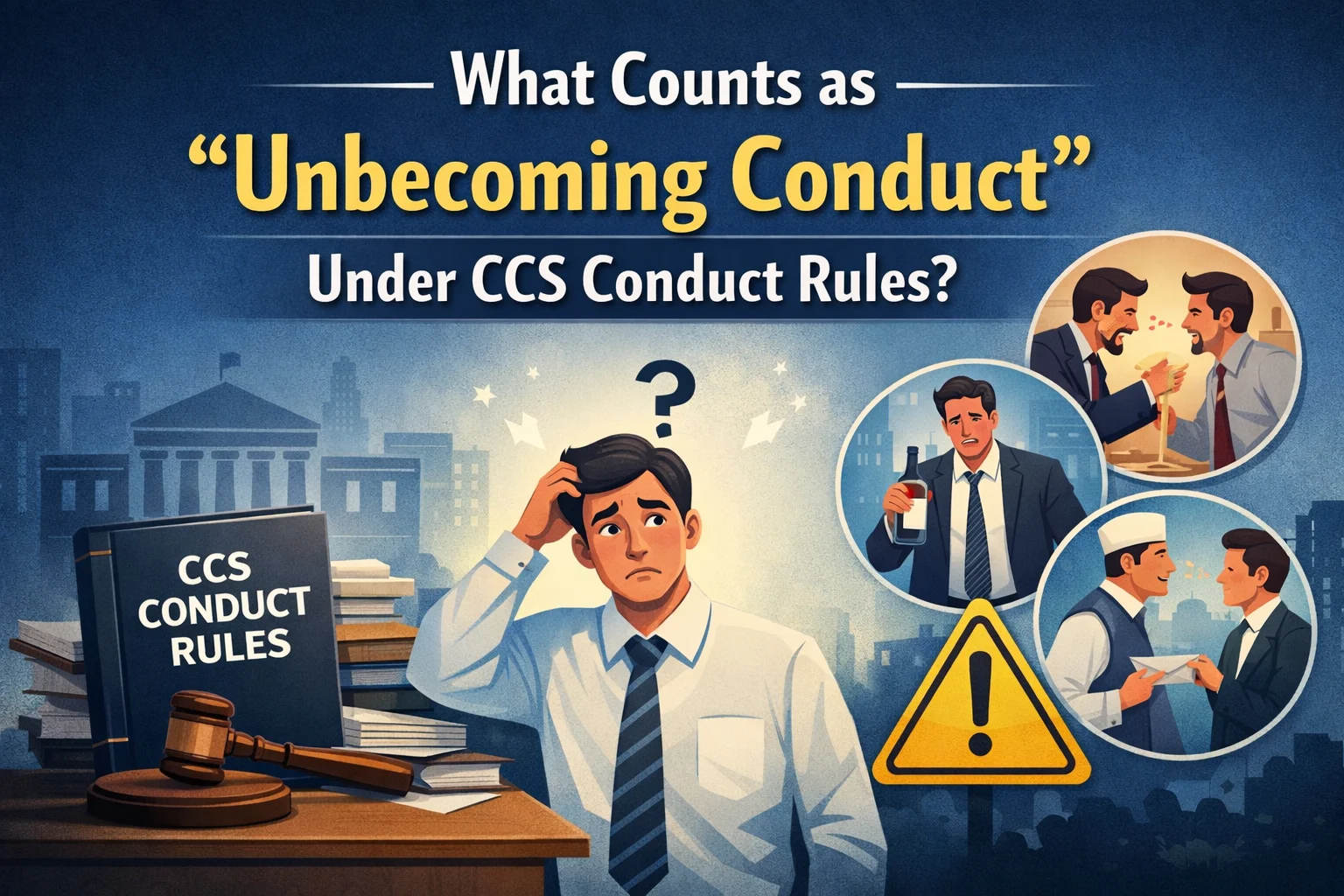
Rule 3(1)(iii) of the CCS (Conduct) Rules is a “catch-all” provision used for misconduct not covered by specific rules. While broad, it requires that the conduct — even in private life or on social media — must genuinely “discredit the service.” Courts and the CAT emphasise that trivial matters or well-disclosed personal relationships cannot be labelled “unbecoming” to harass employees.
Many disciplinary cases against Central Government employees cite Rule 3(1)(iii) of the Central Civil Services (Conduct) Rules, 1964. This rule requires every government servant to fulfil three fundamental obligations:
- Maintain absolute integrity
- Maintain devotion to duty
- Do nothing which is unbecoming of a Government servant
While the first two are specific in scope, “unbecoming conduct” is a broad umbrella — the widest provision in the entire rulebook. This guide clarifies its scope with practical examples and the latest legal safeguards.
What Exactly Qualifies as “Unbecoming Conduct”?
Rule 3(1)(iii) acts as a residual or catch-all provision. Disciplinary authorities invoke this clause only when a specific misconduct is not covered by other rules — for example, Rule 3C for sexual harassment or Rule 13 for gifts and transactions. As established by the Supreme Court and various High Courts, conduct is “unbecoming” if it:
- Brings discredit to the Government or public service
- Undermines public trust in the administration
- Violates the dignity and decorum expected of a public official
Does It Apply to Behaviour Outside the Workplace?
Yes. Unlike the private sector, a government servant is subject to conduct norms around the clock — at home, on social media, and in the community. However, the Government has itself cautioned that trivial or frivolous matters in one’s private life should not be turned into disciplinary cases, and supervisory officers are required during periodic inspections to weed out such frivolous invocations.
Real-World Examples of Unbecoming Conduct
Based on DoPT instructions, Ministry of Home Affairs Office Memoranda, and administrative decisions, the following situations typically attract Rule 3(1)(iii):
With the rise of digital platforms, a government servant’s online life is now squarely under the conduct lens.
Leaked Messages: Engaging in abusive or inflammatory discussions in “private” WhatsApp groups can attract this rule if the content leaks and damages the reputation of the office or the service.
Political Neutrality: While employees retain the right to vote, publicly visible attacks on government policy on platforms like X (Twitter) or Facebook — or any online proselytising — is a frequent trigger for Rule 3(1)(iii).
DoPT has clarified that bypassing proper channels even via email or public grievance portals (CPGRAMS) constitutes unbecoming conduct, confirming that digital communication is fully within the rule’s ambit.
Source: DoPT F. No. 11013/08/2013-Estt(A-III)A Government servant is expected to maintain a responsible standard of behaviour in private life. Serious neglect or physical ill-treatment of a spouse or children can lead to departmental action under Rule 3(1)(iii).
“It has been held that neglect by a Government servant of his wife and family in a manner unbecoming of a Government servant may be regarded as a good and sufficient reason to justify action being taken against him under this rule.”
Source: MHA OM No. 25/16/59-Ests.(A) dated 01.09.1959The legal nuance: If a maintenance case is already pending in court, the Government typically waits for the judicial outcome before finalising its own disciplinary action, to avoid any appearance of contempt of court.
Directly approaching Ministers or senior external authorities for personal service matters — such as transfers, promotions, or pay disputes — without going through one’s own department head is strictly treated as unbecoming conduct.
“Such submission of representations directly to other authorities by-passing the prescribed channel of communication has to be viewed seriously and appropriate disciplinary action should be taken… This can rightly be treated as an unbecoming conduct attracting the provisions of Rule 3(1)(iii)… this would include all forms of communication including through e-mails or public grievances portal etc.”
Source: DoPT F. No. 11013/08/2013-Estt(A-III)The Government has taken an unambiguous position: a Government servant found guilty of the practice of untouchability in any form will be considered unfit for public service and will face departmental action.
“A Government servant who is found guilty of the practice of untouchability in any form will be considered unfit for public service and disciplinary action will be taken against him.”
Source: MHA OM No. F.70/17/61-Ests.(A) dated 08.12.1961, reiterated vide OM No. 25/29/66-Ests.(A) dated 21.01.1967This is notable because the Government frames it as both a violation of Article 17 of the Constitution and the Untouchability (Offences) Act, 1955 — meaning a Government servant could face simultaneous criminal prosecution and departmental action.
Habitual rudeness to members of the public or abusive language toward colleagues is a violation of both Rule 3A (Promptness and Courtesy) and Rule 3(1)(iii) because it lowers the dignity of the office. Single isolated incidents of mild discourtesy are generally not enough; authorities look for a pattern of behaviour or a single act of significant gravity.
Important Legal Safeguards for Employees
The breadth of Rule 3(1)(iii) can cause anxiety, but the law provides a clear safety net through judicial oversight and procedural requirements.
Disciplinary authorities must demonstrate that the act was serious enough to genuinely affect the service. If an employee has been transparent and disclosed personal details in service records, the department cannot retroactively label the same conduct “unbecoming” to withhold pension or other benefits.
The Central Administrative Tribunal (CAT) regularly strikes down “unbecoming conduct” charges that are vague (the charge must specify exactly what act was unbecoming) or arbitrary (the rule cannot be weaponised for minor personal disagreements with a superior).
Official Government instructions themselves direct supervisory officers to ensure that disciplinary proceedings under Rule 3(1)(iii) are not initiated on “trivial” grounds. This is an explicit, standing administrative directive.
Quick Reference: Specific Rules vs. Rule 3(1)(iii)
The table below shows when a more specific rule governs the misconduct, and when the residual Rule 3(1)(iii) applies:
| Nature of Misconduct | Specific Rule | Rule 3(1)(iii) Applies? |
|---|---|---|
| Sexual Harassment | Rule 3C | No — specific rule governs |
| Criticising Government Policy | Rule 9 | No — specific rule governs |
| Strike or Demonstration | Rule 7 | No — specific rule governs |
| Gifts & Financial Transactions | Rules 13, 16, 18 | No — specific rule governs |
| Social Media Abuse | No specific rule | Yes — residual provision |
| Family Neglect | No specific rule | Yes — residual provision |
| Bypassing Proper Channel | No specific rule | Yes — residual provision |
| Practice of Untouchability | No specific rule | Yes — residual provision |
Frequently Asked Questions
📢 Stay Updated with GConnect
Join our Whatsapp channels for the latest news and job updates:
Join GConnect News Join GConnect Jobs
GConnect News
GConnect Jobs
📢 Stay Updated with GConnect
Join our Whatsapp channels for the latest news and job updates:
Join GConnect News Join GConnect JobsGConnect News
GConnect Jobs
You might also like:
Central Government Holiday List — 2027
DoPT Advises Central Government Employees to Book LTC Air Tickets at Least 21 Days in Advance
PFRDA Directs NPS Service Providers to Strengthen Accessibility Standards for Persons with Disabilities
PFRDA Launches NPS PRIDE-DISHA Tool to Help Subscribers Compare Pension Fund Performance
Government Warns Departments Over Delayed NPS Contribution Remittances, Directs Strict Compliance with Interest Rules
MHA Issues Comprehensive Guidelines on Singing and Playing the National Anthem and National Song