
So What’s the Real Story with the 8th Pay Commission?
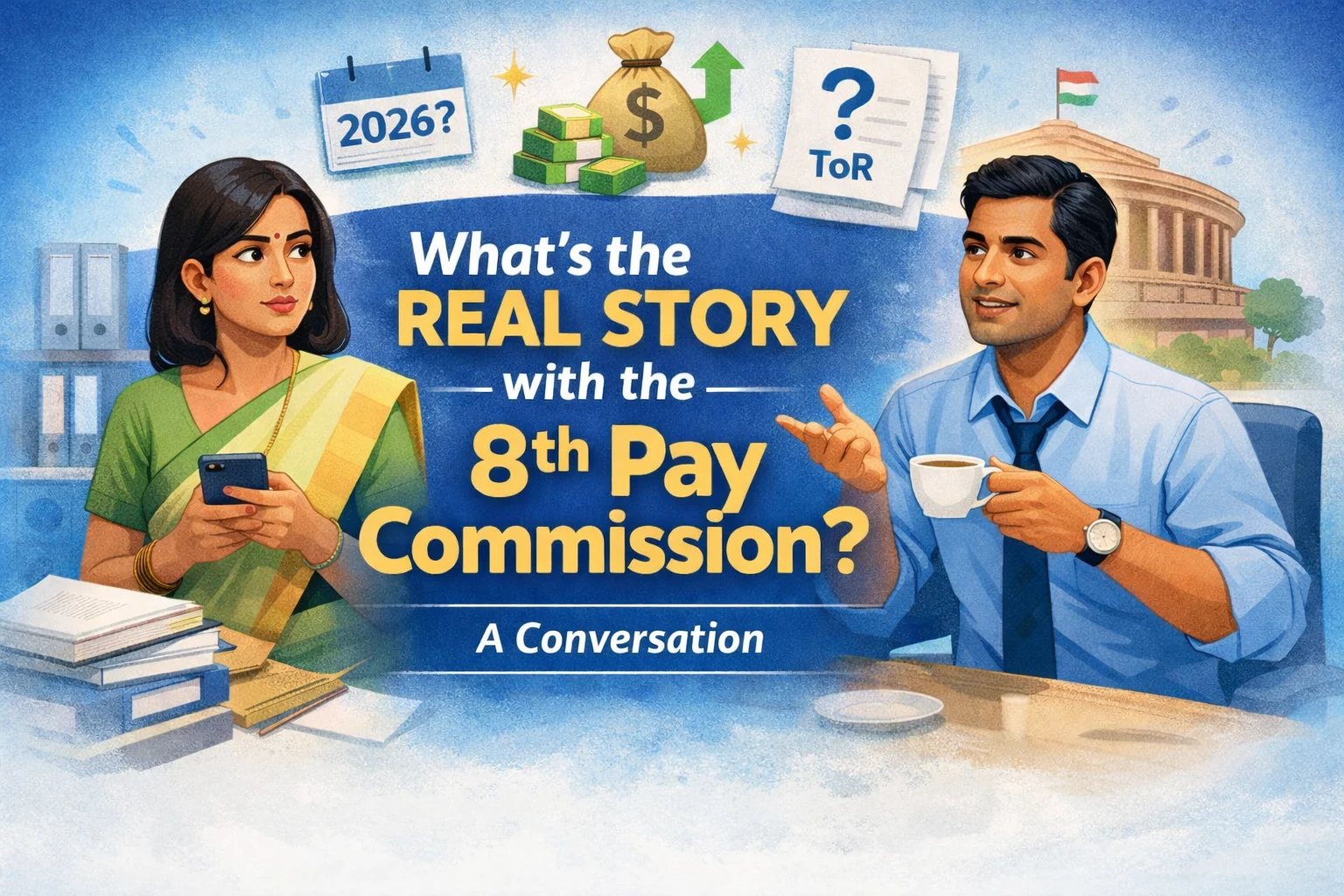
An imaginary — but very relatable — conversation between two Central Government colleagues
It was a Tuesday morning, somewhere between the end of a long section meeting and the beginning of actual work. Arvind, a Section Officer in the Ministry of Finance with sixteen years of service, was on his second cup of chai in the pantry when Meena walked in — an Assistant Section Officer from the neighbouring department, phone in hand, frowning at the screen like it had personally offended her.
Meena was the kind of person who always knew what was happening before the official circular came out. Eleven years in service, sharp, no-nonsense, and with zero patience for rumours dressed up as facts.
You look stressed. Bad news or bad WhatsApp forward?
(snorts) Guess. My husband just sent me another message — “8th Pay Commission will double salaries!” Three exclamation marks. Apparently, it’s already decided.
(laughs) Ah, the famous triple-exclamation confirmation. My wife saw something similar last week. She’s already planning a new sofa.
That’s exactly the problem. People are building castles in the air and nobody is actually reading what’s happening on the ground. So I tried to piece together the real picture.
Actually, same here. What have you figured out so far?
The 8th Central Pay Commission has been formally constituted. The Chairperson and members have been appointed, and the Terms of Reference have also been notified. So this time, it’s not just talk — the commission is real.
But that doesn’t mean implementation is around the corner.
Exactly. The commission has an 18-month window to submit its report. Even if January 1, 2026 is chosen as the effective date, actual implementation could stretch into late 2026 or even 2027 — with arrears paid from the effective date.
One year of arrears will still feel like a bonus.
True. But the real suspense is around the fitment factor. That’s where expectations either rise or crash.
I’ve seen estimates ranging from 1.83 to 3.68 online.
None of that is official. Most realistic estimates place it somewhere between 1.9 and 2.3. Employee unions have demanded higher numbers, but fiscal constraints matter.
At 2.0 itself, it’s a solid jump.
Absolutely. And don’t forget DA. By the time the new pay structure kicks in, DA could be around 65%. That entire amount gets merged into the new basic and DA resets to zero.
So the real increase is fitment plus DA neutralisation.
Exactly. That’s why headline figures don’t tell the full story.
OPS keeps coming up in every discussion.
OPS restoration is a separate policy issue. It’s not part of the Pay Commission’s Terms of Reference. The commission works within the existing pension framework.
Pensioners will still benefit though.
Yes. Pension revision is very much within scope. Even a modest fitment factor can significantly improve minimum pensions.
And this affects a huge number of people.
Roughly 50 lakh serving employees and around 60–65 lakh pensioners. Over a crore households directly affected — with wider economic spill-over effects too.
I heard the government has invited suggestions through MyGov this time.
Yes. That’s a positive step. Employees, pensioners, and even the public can submit inputs. It’s a more open consultation process than earlier pay commissions.
(smiling) So the takeaway — ignore WhatsApp hype, follow official sources.
Exactly. And for accurate updates, stick to reliable platforms like GConnect.
📢 Stay Updated with GConnect
Join our Whatsapp channels for the latest news and job updates:
Join GConnect News Join GConnect Jobs
GConnect News

GConnect Jobs