
8th Central Pay Commission Launches Official Website, Invites Comprehensive Stakeholder Input
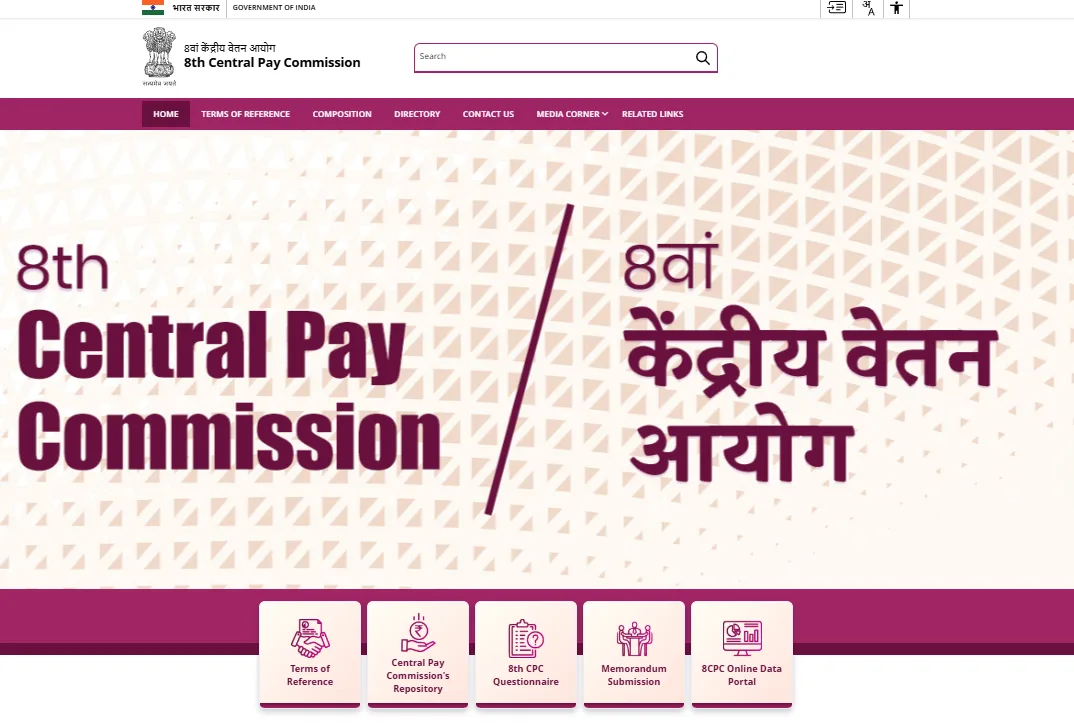
The Government of India has taken a major procedural step in advancing the 8th Central Pay Commission (8th CPC) by launching its official digital platform, marking the formal commencement of the Commission’s work to review pay structures, allowances, and pensions for central government employees and pensioners.
The website — 8cpc.gov.in — now serves as the central hub for official documentation, engagement tools, notifications, and public consultations related to the Commission’s activities. It reflects a digital-first and participative approach that aims to broaden transparency and inclusivity in the pay revision process.
What the New 8th CPC Website Offers
The official homepage of the Eighth Central Pay Commission, developed and hosted by the National Informatics Centre (NIC) for the Government of India, is structured to support both public engagement and institutional processes. Key sections and features include:
🔹 Terms of Reference (ToR)
A detailed outline of the Commission’s mandate, scope, and objectives. This defines the areas the Commission will examine — ranging from basic pay to allowances and service conditions.
🔹 Central Pay Commission’s Repository
An archive of past and current documents, including official gazette notifications and press releases. This repository will be crucial for researchers and stakeholders tracking progress and historical context.
🔹 8th CPC Questionnaire
A dedicated section where stakeholders can access the structured questionnaire designed to collect feedback on salary, pensions, allowances, and other key elements.
🔹 Memorandum Submission
An online portal (or soon-to-be-activated links) allowing associations, unions, individuals, and departments to submit formal representations and detailed memoranda directly to the Commission.
🔹 8CPC Online Data Portal
A separate digital channel for government ministries, departments, and units to securely upload institutional data necessary for analytical work and decision-making.
🔹 Directory and Contact Information
Details of the Commission’s leadership and appointed members — including the Chairperson, Members, and Member-Secretary — to help the public connect with official contacts.
Structured Public Consultation Underway
One of the most significant features of the new website is the integration of public consultation mechanisms. Central government employees, pensioners, judicial officers, regulatory body members, researchers, and even individual citizens can submit structured feedback using the 8th CPC questionnaire, hosted in collaboration with the MyGov platform.
The questionnaire spans multiple topics related to pay, allowances, retirement benefits, and service conditions — with responses accepted until 16 March 2026.
Participation is open to:
- Serving central government employees
- Employees of Union Territories
- Judicial officers, courts officials, and regulatory body personnel
- Pensioners and representatives of associations/unions
- Academics, researchers, and other interested parties
This structured approach helps ensure that recommendations are informed by a broad spectrum of stakeholder views rather than top-down policy choices alone.
Why the Website Matters
While the 8th CPC’s Terms of Reference were approved in October 2025 and the Commission formally constituted in November 2025, the launch of a dedicated digital platform is the first tangible milestone in its workflow.
In comparison to earlier pay commissions, this marks:
- Greater transparency through public access to documents and processes.
- Active engagement across millions of potential contributors.
- Centralised information dissemination replacing fragmented notices across departments.
- A technologically modern consultation process, aligned with India’s push towards digital governance.
The website’s structured sections aim to streamline the process from data collection to final analysis — a critical step given the Commission’s expected 18-month timeline to submit its comprehensive report.
📢 Stay Updated with GConnect
Join our Whatsapp channels for the latest news and job updates:
Join GConnect News Join GConnect Jobs
GConnect News

GConnect Jobs