
Government Employees Can Hold Elective Office Only for Two Terms or Five Years: DoPT Clarifies Rules
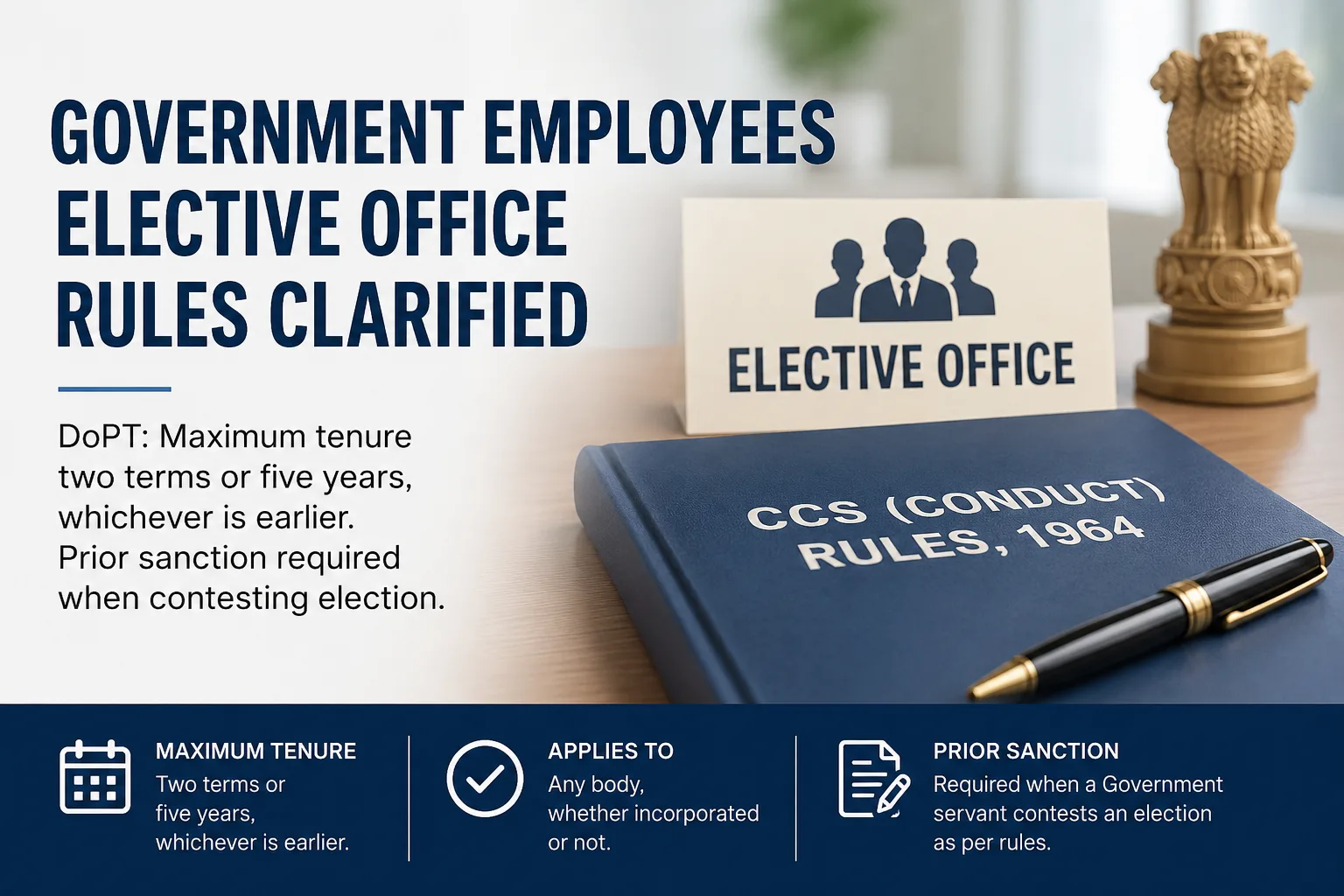
Central Government employees may hold an elective office in any body for a maximum of two terms or five years, whichever is earlier, the Government has clarified in the Lok Sabha. Prior sanction is also required when a Government servant contests an election to such a body under the applicable conduct rules.
The Government has clarified the rules governing Central Government employees holding elective positions in associations, organisations and other bodies, stating that the prescribed tenure restriction applies to “any body, whether incorporated or not.”
The clarification was given by Minister of State for Personnel, Public Grievances and Pensions Dr. Jitendra Singh in a written reply to Lok Sabha Unstarred Question No. 491 on July 22, 2026.
Maximum Tenure: Two Terms or Five Years
According to the Government, instructions have been issued to all Ministries and Departments stipulating that a Government servant may hold an elective office in any body for:
- Two terms, or
- Five years
whichever is earlier.
This means that even where the rules of an association or organisation permit a longer tenure or additional terms, a serving Government employee would remain subject to the restrictions prescribed under the Government’s instructions.
Rule Applies to “Any Body, Whether Incorporated or Not”
An important aspect of the Lok Sabha reply is the Government’s use of the expression “any body, whether incorporated or not.”
The parliamentary question had specifically sought clarification on whether the restriction was confined to Government-affiliated sports associations and federations or whether it also extended to other organisations.
Examples raised in the question included:
- Durga Puja Samities
- Ram Leela Committees
- Jagran Committees
- Private associations and federations
- Religious organisations
- Bodies registered under the Trust or Societies framework
- Unregistered bodies
Instead of prescribing separate rules for each category mentioned in the question, the Government stated that a Government servant may hold elective office in any body, whether incorporated or not, subject to the prescribed tenure restriction and applicable rules.
The wording therefore makes the clarification broader than merely sports associations or federations.
Prior Sanction Required for Contesting Election
The Government has also clarified the requirement regarding prior permission.
According to the reply, prior sanction is required when a Government servant contests an election in such a body, in accordance with the existing rules.
Government employees intending to contest an election for an office in an association or other body should therefore ensure that the necessary sanction has been obtained from the competent authority wherever required under the applicable conduct rules.
Competent Authority Must Consider Relevant Factors
The Government further stated that the competent authority is required to keep all relevant factors in mind while considering permission.
Such permission is governed by Rule 15(1)(c) of the Central Civil Services (Conduct) Rules, 1964.
The provision relating to prior sanction is therefore not merely procedural. The competent authority is expected to examine the relevant circumstances before granting permission to the Government employee concerned.
What the Clarification Means for Central Government Employees
The Lok Sabha reply provides an important clarification for employees who participate in associations, committees, federations and similar organisations.
The key principle is that the tenure restriction is expressed in broad terms and applies to elective office in any body, whether incorporated or not.
Accordingly, Central Government employees considering an elected position in an outside body should keep two requirements in mind: the tenure is limited to two terms or five years, whichever is earlier, and prior sanction is required for contesting an election as prescribed under the existing rules.
Employees should therefore obtain the required departmental approval before contesting such elections rather than assuming that permission requirements apply only to particular categories such as sports associations.
Government’s Clarification at a Glance
| Issue | Government’s Clarification |
|---|---|
| Maximum period for holding elective office | Two terms or five years, whichever is earlier |
| Bodies covered | Any body, whether incorporated or not |
| Prior sanction | Required when a Government servant contests an election, as per existing rules |
| Governing provision | Rule 15(1)(c) of CCS (Conduct) Rules, 1964 |
| Authority granting permission | Competent Authority |
| Factors for granting permission | All relevant factors must be considered |
Background
The clarification came in response to a question raised by Lok Sabha MP Bhausaheb Rajaram Wakchaure, who sought details regarding the applicability of DoPT instructions concerning Government servants holding elective office.
The question referred to DoPT Office Memoranda No. 11013/1/2016-Estt.A-III dated February 27, 2020 and August 5, 2019 and sought clarification on their application to different kinds of organisations.
Responding to all parts of the question together, the Government reiterated that a Government servant may hold elective office in any body, incorporated or otherwise, only for two terms or five years, whichever is earlier, and that prior sanction is required when contesting an election in accordance with the existing rules.
The clarification is particularly relevant to Central Government employees who are office-bearers or intend to contest elections in associations, federations, committees or other organised bodies outside their official duties.
View PQ:
 Loading…

 Reload document
  Open in new tab
 📢 Stay Updated with GConnect
Join our Whatsapp channels for the latest news and job updates:
Join GConnect News Join GConnect Jobs
GConnect News

GConnect Jobs
📢 Stay Updated with GConnect
Join our Whatsapp channels for the latest news and job updates:
Join GConnect News Join GConnect JobsGConnect News
GConnect Jobs
You might also like:
Government Clarifies No MACP Benefits for Central Employees Who Retired Before 1 September 2008
Government Says Income Tax e-Filing Portal Stable Despite Peak Load, Confirms Penalties on Infosys for Past Lapses
CBDT Has 26,997 Vacancies as of January 2026, Government Tells Lok Sabha
CGHS Integrates with Bhavishya Portal to Simplify Pensioner Card Process for Retiring Central Government Employees
Government Revises GPRA Licence Fee Across India from 1 July 2026
Railway Board Directs Zones to Expedite Pending Notional Increment Cases for June 30 Retirees